

Generative AI for Bio-Inspired Materials & Biodegradable Polymer LCA
Design Smarter, Greener Polymers with Generative AI and Lifecycle Intelligence
Skills you will gain:
About Program:
Bio-inspired materials and biodegradable polymers are at the forefront of sustainable innovation, offering alternatives to petroleum-based plastics in packaging, biomedical devices, and environmental applications. However, designing high-performance biodegradable materials requires balancing mechanical strength, degradation behavior, cost, and ecological safety. Generative AI models—such as deep generative networks and material foundation models—are transforming this process by enabling rapid exploration of polymer formulations, predicting structure–property relationships, and guiding eco-friendly material discovery.
This workshop explores how Generative AI combined with LCA frameworks can support sustainable polymer development from concept to real-world deployment. Participants will learn dry-lab workflows for AI-based material design, predictive modeling of biodegradation, and lifecycle carbon accounting. The program highlights future-ready applications in green nanotechnology, circular materials engineering, and data-driven sustainability assessment for next-generation biodegradable polymers.
Aim: This workshop aims to introduce participants to the use of Generative AI in designing bio-inspired and biodegradable materials with a focus on sustainability and lifecycle performance. It emphasizes how AI-driven models can accelerate polymer innovation while reducing environmental impact. Participants will learn how Life Cycle Assessment (LCA) integrates with AI to evaluate carbon footprint, biodegradability, and circular economy potential. The program bridges materials science, green chemistry, and AI-powered sustainability analytics.
Program Objectives:
- Understand generative AI concepts applied to bio-inspired material design.
- Learn predictive modeling of biodegradable polymer properties and performance.
- Explore lifecycle assessment tools for sustainability and carbon impact evaluation.
- Integrate AI-driven material discovery with circular economy principles.
- Discuss regulatory and industrial adoption of sustainable polymer solutions.
What you will learn?
Day 1: Generative Design of Bio-Polymers
Focus: How AI invents new chemical structures.
- Theory : Introduction to generative models in chemistry (Variational Autoencoders). Translating 3D chemical structures into machine-readable text (SMILES notation).
- Hands-On : * Accessing a pre-trained generative chemical AI model via Google Colab.
- Generating a batch of novel SMILES strings targeted for polymer characteristics (e.g., mimicking the traits of Polylactic Acid – PLA).
- Filtering out physically impossible or unstable chemical generations.
Day 2: AI Screening for Biodegradability & Eco-Toxicity
Focus: Ensuring the generated materials are actually safe for the environment.
- Theory: Understanding QSAR (Quantitative Structure-Activity Relationship) models. How AI predicts how long a molecule will take to break down in soil or marine environments.
- Hands-On :
- Taking the novel biopolymers generated on Day 1 and passing them through predictive ML classifiers.
- Calculating theoretical degradation timelines and aquatic toxicity scores (e.g., LC50 for marine life).
- Ranking and selecting the top 3 most promising, non-toxic bio-polymer candidates.
Day 3: Computational LCA & Carbon Footprint Simulation
Focus: Quantifying the environmental impact of the new material.
- Theory: The framework of predictive Life Cycle Assessment. How to build a system boundary for a material that doesn’t physically exist yet.
- Hands-On: *
- Using Python to build a simplified early-stage Life Cycle Inventory (LCI) for the top AI-generated polymer.
- Calculating the theoretical Global Warming Potential (GWP – Carbon Footprint) of synthesizing the new material compared to standard PET plastic using programmatic emission factors.
Mentor Profile
Fee Plan
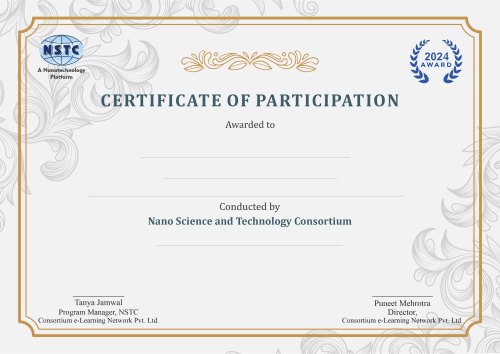
Get an e-Certificate of Participation!
Intended For :
- Doctoral Scholars & Researchers: PhD candidates seeking to integrate computational workflows into their molecular research.
- Postdoctoral Fellows: Early-career scientists aiming to enhance their data-driven publication profile.
- University Faculty: Professors and HODs interested in modern bioinformatics pedagogy and tool mastery.
- Industry Scientists: R&D professionals from the Biotechnology and Pharmaceutical sectors transitioning to genomic-driven discovery.
- Postgraduate Students: Final-year PG students looking for specialized research-grade exposure beyond standard curricula.
Career Supporting Skills
Program Outcomes
Participants will be able to:
- Apply generative AI concepts to sustainable polymer and biomaterial design.
- Understand how LCA frameworks quantify environmental impact.
- Predict biodegradability and performance trade-offs using AI models.
- Evaluate carbon footprint and circularity potential of polymer systems.
- Propose eco-friendly material solutions for industrial and research applications.