

Sustainable Nanomaterials for Drug Delivery and Biomedical Innovation
Driving Biomedical Innovation with Sustainable Nanomaterials for Precision Drug Delivery
Skills you will gain:
About Program:
This 3-day workshop covers the foundations, design, and applications of sustainable nanomaterials in drug delivery. Day 1 introduces nanomaterial types, green synthesis methods, and basic drug delivery principles. Day 2 focuses on design, characterization, and optimization, including surface properties, morphology, and advanced microscopy techniques. Day 3 explores clinical applications, regulatory frameworks, translational challenges, and future trends, including AI-powered drug design and personalized medicine. Participants gain hands-on experience using Python, RDKit, Scikit-learn, TensorFlow, and Streamlit for modeling, analysis, and visualization.
Aim:
This workshop aims to provide a comprehensive understanding of sustainable nanomaterials for biomedical applications, focusing on drug delivery systems. Participants will learn green and biocompatible nanomaterial design, advanced characterization techniques, and optimization strategies. The course integrates hands-on modeling and AI-based tools for designing effective nanocarriers. Attendees will also explore clinical translation, regulatory considerations, and emerging trends in personalized and smart nanomedicine.
Program Objectives:
- Learn principles of sustainable and biocompatible nanomaterial design.
- Understand drug encapsulation, release kinetics, and targeting strategies.
- Gain proficiency in nanomaterial characterization using TEM, SEM, AFM.
- Optimize nanocarrier properties using AI and data-driven modeling.
- Explore clinical applications, regulatory compliance, and future trends in nanomedicine.
What you will learn?
📅 Day 1: Foundations of Sustainable Nanomedicine
- Core Objective: Understand the fundamentals of sustainable nanomedicine by exploring nanomaterials, green synthesis methods, and drug delivery principles.
- Introduction to nanomaterials in medicine: liposomes, dendrimers, carbon nanotubes, and other nanocarrier systems
- Principles of sustainable nanomaterial design using eco-friendly and biocompatible approaches
- Green synthesis of nanomaterials: methods, challenges, and advantages
- Fundamentals of drug delivery systems: encapsulation, release kinetics, and bioavailability
- Basic modeling and visualization of nanomedicine-related data
🛠️ Hands-on:
- Hands-on Lab: Use Python-based modeling to analyze and visualize basic drug release and bioavailability data in Google Colab.
🧰 Tools Covered: Python, Pandas, Matplotlib, Google Colab/Jupyter
📅 Day 2: Design, Characterization & Optimization
- Core Objective: Learn how nanomaterials are designed, characterized, and optimized for efficient and targeted drug delivery applications.
- Nanomaterial design for drug delivery: structure-property relationships and targeting strategies
- Characterization of nanomaterials: surface charge, morphology, size distribution, and stability analysis
- Advanced characterization techniques: Transmission Electron Microscopy (TEM), Scanning Electron Microscopy (SEM), and Atomic Force Microscopy (AFM)
- Optimization of nanocarriers based on size, shape, and surface modification
- Analyzing the effect of nanocarrier properties on drug loading and release performance
🛠️ Hands-on:
- Hands-on Lab: Build a basic nanocarrier property analysis workflow using RDKit, Scikit-learn, Pandas, NumPy, and visualization tools in Google Colab.
🧰 Tools Covered: RDKit, Scikit-learn, Pandas, NumPy, Jupyter/Colab, Matplotlib
📅 Day 3: Applications, Translation & Future Directions
- Core Objective: Explore clinical applications, regulatory pathways, translation challenges, and future innovations in sustainable nanomedicine.
- Clinical applications of nanomedicine in targeted drug delivery, cancer therapy, and gene delivery
- Regulatory considerations: FDA guidelines and global regulatory bodies for nanomedicine
- Challenges in translating nanomaterials to clinical use: scale-up, stability, safety, and patient-specific factors
- Future trends in nanomedicine: personalized medicine, smart nanomaterials, and AI-powered drug design
- Using machine learning and simple UI tools to support nanomedicine data analysis and decision-making
🛠️ Hands-on:
- Hands-on Lab: Create a simple AI-assisted nanomedicine data analysis workflow and deploy a basic interactive interface for visualization.
🧰 Tools Covered: TensorFlow/Keras, Streamlit, Scikit-learn
Mentor Profile
Fee Plan
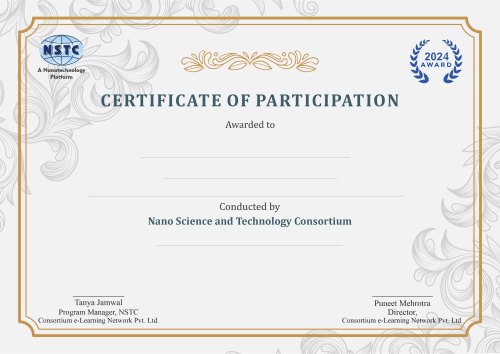
Get an e-Certificate of Participation!
Intended For :
- Doctoral Scholars & Researchers: PhD candidates seeking to integrate computational workflows into their molecular research.
- Postdoctoral Fellows: Early-career scientists aiming to enhance their data-driven publication profile.
- University Faculty: Professors and HODs interested in modern bioinformatics pedagogy and tool mastery.
- Industry Scientists: R&D professionals from the Biotechnology and Pharmaceutical sectors transitioning to genomic-driven discovery.
- Postgraduate Students: Final-year PG students looking for specialized research-grade exposure beyond standard curricula.
Career Supporting Skills
Program Outcomes
- Ability to design and synthesize eco-friendly nanomaterials for drug delivery.
- Hands-on experience in modeling and AI-assisted nanocarrier optimization.
- Proficiency in advanced characterization techniques (TEM, SEM, AFM).
- Understanding of clinical translation, regulatory frameworks, and patient-specific considerations.
- Knowledge of emerging trends like personalized medicine and AI-driven drug design.