
- Classify Spectra with 1D-CNNs for enhanced accuracy.
- Denoise Spectral Data using AI techniques for better trace detection.
- Optimize Preprocessing with methods like baseline correction and data augmentation.
- Automate Feature Extraction from spectral data.
- Enhance Sensor Data Analysis in chemical sensing, biotech, and environmental monitoring.
New Year Offer End Date: 30th April 2024

Virtual Workshop
Smart Sensors: 1D-CNNs and Signal Processing for Spectroscopy
Enhancing Spectral Analysis: AI-Powered 1D-CNNs for Classification and Denoising
Skills you will gain:
About Workshop:
Smart Sensors: 1D-CNNs and Signal Processing for Spectroscopy teaches AI-driven techniques to enhance Raman, Fluorescence, and IR spectroscopy. Learn to use 1D-CNNs for classification, denoising, and spectral preprocessing, improving data quality for trace detection. Ideal for researchers in chemical sensing, biotech, and environmental monitoring, this hands-on workshop provides tools for advanced spectral analysis.
Aim: To equip researchers with AI-driven techniques using 1D-CNNs and signal processing to enhance spectral data analysis, improving classification, denoising, and trace detection in Raman, Fluorescence, and IR spectroscopy.
Workshop Objectives:
What you will learn?
📅 Day 1 — Spectral Preprocessing & Augmentation
- Lecture: Overview of spectral data cleaning—baseline correction, smoothing, and the importance of data augmentation for improving model robustness.
- Lab: Hands-on experience with Python (scipy.signal) to preprocess raw Raman/Fluorescence spectra and apply augmentation techniques like synthetic noise and shifts.
- Deliverable: Preprocessed, augmented spectral dataset ready for deep learning model training and analysis.
📅 Day 2 — 1D-Convolutional Neural Networks (CNNs) for Spectral Classification
- Lecture: Understanding the advantages of 1D-CNNs over traditional PCA for spectral classification. Learn how CNNs can automatically extract spectral features (e.g., peaks, shoulders) without manual intervention.
- Lab: Practical session on training a 1D-CNN to classify spectral data, such as Acidic vs. Basic or Toxin Present vs. Absent, using raw spectral fingerprints.
- Deliverable: Trained 1D-CNN model capable of classifying spectral data based on learned features.
📅 Day 3 — Denoising Autoencoders for Spectral Data Enhancement
- Lecture: Introduction to super-resolution for spectroscopy. Learn how Autoencoders can be applied to remove noise and reconstruct high-fidelity signals from low-quality spectra.
- Lab: Hands-on training on using Autoencoders to denoise spectra and reconstruct clean data for trace detection applications in spectroscopy.
- Deliverable: Trained Autoencoder model that enhances noisy spectra, improving detection limits and data quality.
Mentor Profile
Fee Plan
StudentINR 2499/- OR USD 75
Ph.D. Scholar / ResearcherINR 3499/- OR USD 85
Academician / FacultyINR 4499/- OR USD 105
Industry ProfessionalINR 6499/- OR USD 120
Important Dates
Registration Ends
27 Dec 2025 Indian Standard Timing 4:30 PM
27 Dec 2025 Indian Standard Timing 4:30 PM
Workshop Dates
25 Jan 2026 to 27 Jan 2026 Indian Standard Timing 5: 30PM
25 Jan 2026 to 27 Jan 2026 Indian Standard Timing 5: 30PM
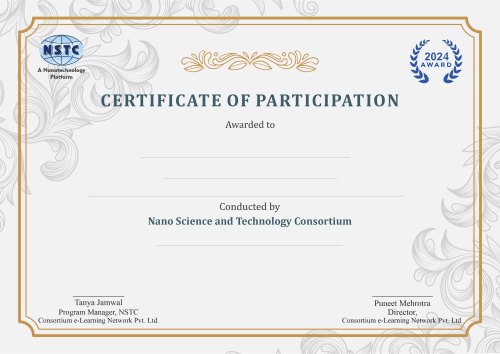
Get an e-Certificate of Participation!
Intended For :
- Doctoral Scholars & Researchers: PhD candidates seeking to integrate computational workflows into their molecular research.
- Postdoctoral Fellows: Early-career scientists aiming to enhance their data-driven publication profile.
- University Faculty: Professors and HODs interested in modern bioinformatics pedagogy and tool mastery.
- Industry Scientists: R&D professionals from the Biotechnology and Pharmaceutical sectors transitioning to genomic-driven discovery.
- Postgraduate Students: Final-year PG students looking for specialized research-grade exposure beyond standard curricula.
Career Supporting Skills
Workshop Outcomes
- Expertise in 1D-CNNs for spectral classification.
- Ability to denoise spectral data for precise trace detection.
- Mastery of spectral preprocessing and data augmentation techniques.
- Skills in automated feature extraction from spectral data.
- Advanced capability in sensor data analysis across chemical sensing, biotech, and environmental monitoring.