
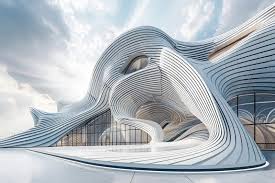
AI-driven Adaptive Architecture for Climate Resilience
urning weather into signals—and buildings into responses.
Skills you will gain:
About Program:
A three-day, hands-on workshop to build an AI-assisted workflow that unites microclimate data, simulation, and ML to predict heat/wind/flash-flood stress, auto-tune façades/ventilation, and deploy closed-loop building- and canyon-scale controls with decision-grade KPIs.
Aim: Equip participants to build an end-to-end AI workflow that predicts heat/wind/flash-flood stress, auto-tunes façades/shading/ventilation, and deploys closed-loop controls and urban-canyon adaptations with decision-grade KPIs.
Program Objectives:
-
Establish resilience KPIs & microclimate drivers.
-
Assemble site data; run baseline E+/Honeybee/URBANopt/CFD; extract features.
-
Train/validate fast ML surrogates for heat, wind, and flood.
-
Optimize façade/shading/ventilation; auto-generate control schedules.
-
Design rule-based/MPC control loops with sensing & fail-safes.
-
Evaluate canyon-scale strategies; stress-test (heatwave + storm); deliver KPI dashboard & reproducible workflow.
What you will learn?
📅 Day 1 – Fundamentals of CO₂ Capture, Catalysts & Data
- CO₂ Capture Routes & Products: post-/pre-combustion, DAC; RWGS, methanation, methanol
- Catalyst Families & Characterization: Ni/Co/Cu, bimetallics, perovskites; BET, XRD, XPS, TPD
- Data & Formats: OpenCatalyst/NIST, CSV/Parquet/JSON; units, metadata, reproducibility
- Thermo–Kinetics Essentials: selectivity, activity, stability; mass/heat transfer basics
- ML Landscape: baselines (ridge/XGB), feature engineering (DFT descriptors), GNNs
- Hands-on: Build a tidy catalyst dataset; normalize units; run EDA and simple baselines
📅 Day 2 – ML for Catalyst Design, Screening & Uncertainty
- Representations: graphs for crystals/surfaces, SMILES, SOAP; Δ-learning on top of DFT
- Modeling: message-passing GNNs, attention, transfer learning; multi-task property prediction
- Uncertainty & Calibration: ensembles, heteroscedastic heads, conformal prediction; CRPS
- Design of Experiments & BO: constraints (stability/cost), explore–exploit trade-offs
- Hands-on: Train a compact GNN on adsorption energies (OC subset); evaluate Top-K hits
📅 Day 3 – Process Integration, TEA/LCA & Operationalization
- Reactor & Process Options: fixed-bed, slurry, microchannel; RWGS/methanation loops
- TEA & LCA: cost drivers, carbon intensity, system boundaries (ISO 14040/44), sensitivity
- Monitoring & Control: soft sensors, digital twins, MPC basics for selectivity/yield
- MLOps: data pipelines, validation, drift monitoring, model cards & governance
- Safety & Compliance: HAZOP overview, IEC 61511, GHG Protocol reporting snapshots
- Hands-on: One-page concept report—flowsheet, KPIs, TEA/LCA snapshots, candidate shortlist
Mentor Profile
Fee Plan
Get an e-Certificate of Participation!
Intended For :
-
Architects, façade/building services engineers, and urban designers/planners
-
Building performance/ESG/resilience leads and sustainability consultants
-
CFD/modeling practitioners and data/ML engineers working in AEC
-
Graduate students/researchers in architecture, civil/environmental engineering, and urban climate
-
Municipal resilience/Smart City teams and risk/climate adaptation professionals
Career Supporting Skills
Program Outcomes
-
ML predictors for heat, wind, and flash-flood stress
-
Auto-tuned façade/shading/ventilation + control schedules
-
Closed-loop controller (rule-based/MPC-ready) with fail-safes
-
Urban-canyon adaptation plan with trade-off analysis
-
KPI dashboard and a reproducible end-to-end workflow/templates