
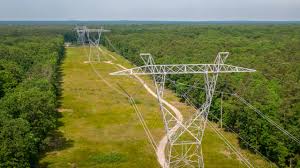
Computer-Vision Drone Inspector for Transmission Lines & Wild-Fire Risk.
Empowering Precision Inspections: Transforming Transmission Line Monitoring and Wildfire Risk Assessment with Drone-Based Computer Vision.
Skills you will gain:
This workshop trains participants to use drone-based computer vision for inspecting transmission lines and assessing wildfire risks. It covers data capture, flight planning, model development for defect detection and vegetation encroachment, and risk mapping, enabling participants to generate actionable reports for improved safety and decision-making.
Aim: The aim of this workshop is to teach participants how to use drone-based computer vision for inspecting transmission lines and assessing wildfire risks, covering data capture, model development, and integration of risk mapping for actionable insights.
*]:pointer-events-auto scroll-mt-[calc(var(–header-height)+min(200px,max(70px,20svh)))]” dir=”auto” data-turn-id=”request-WEB:2d0bd553-affd-4c19-860e-dcc242b17a36-11″ data-testid=”conversation-turn-24″ data-scroll-anchor=”true” data-turn=”assistant”>
-
Master drone operations for transmission line inspections and wildfire risk assessment.
-
Learn flight planning, safety compliance, and data capture techniques.
-
Develop computer vision models for defect detection and vegetation monitoring.
-
Integrate computer vision outputs with wildfire risk data for actionable maps.
-
Generate reports combining inspection findings and risk analysis.
What you will learn?
📅 Day 1 – Foundations & Data Capture
- Mission scope: defects, vegetation encroachment, wildfire ignition cues
- Platforms & payloads: multirotor vs fixed-wing; RGB/thermal/multispectral; radiometric & geo calibration
- Flight planning & compliance: geofencing, BVLOS limits, safety near energized lines
- Data & labels: imagery/video, orthos/point clouds; annotation schema & severity tags
- Hands-on: Plan a corridor mission (flight lines, camera settings) and produce a data-collection checklist
📅 Day 2 – Computer Vision Pipeline
- Preprocessing: sync/geotag, deblur/distortion, tiling, class balance
- Models: detection/segmentation for hardware & insulators; vegetation encroachment; thermal hotspot flags
- Robustness & evaluation: glare/motion/scale, active learning; precision/recall, per-class AP, uncertainty gates
- Hands-on: Fine-tune a compact detector+segmenter and export inference (boxes/masks) with a defect/encroachment summary
📅 Day 3 – Wildfire Risk & Operations
- Risk layers: fuel dryness, slope/aspect, weather/Red-Flag indices, proximity to lines, prior ignitions
- Fusion & workflow: combine CV outputs with terrain/weather; triage queue, human-in-the-loop, CMMS ticketing
- Deployment: edge vs cloud inference, bandwidth limits, encryption, model drift/rollback
- Hands-on: Build a corridor risk map and generate a one-page report with geotagged findings, risk ranking, and actions

Intended For :
-
Professionals in electrical engineering and infrastructure maintenance
-
Researchers in wildfire management and environmental monitoring
-
Individuals working with drone technology, computer vision, or data analytics
-
Those involved in transmission line inspection and vegetation management
-
Professionals focused on wildfire risk assessment
-
Basic knowledge of drones and computer vision recommended but not required
Career Supporting Skills