
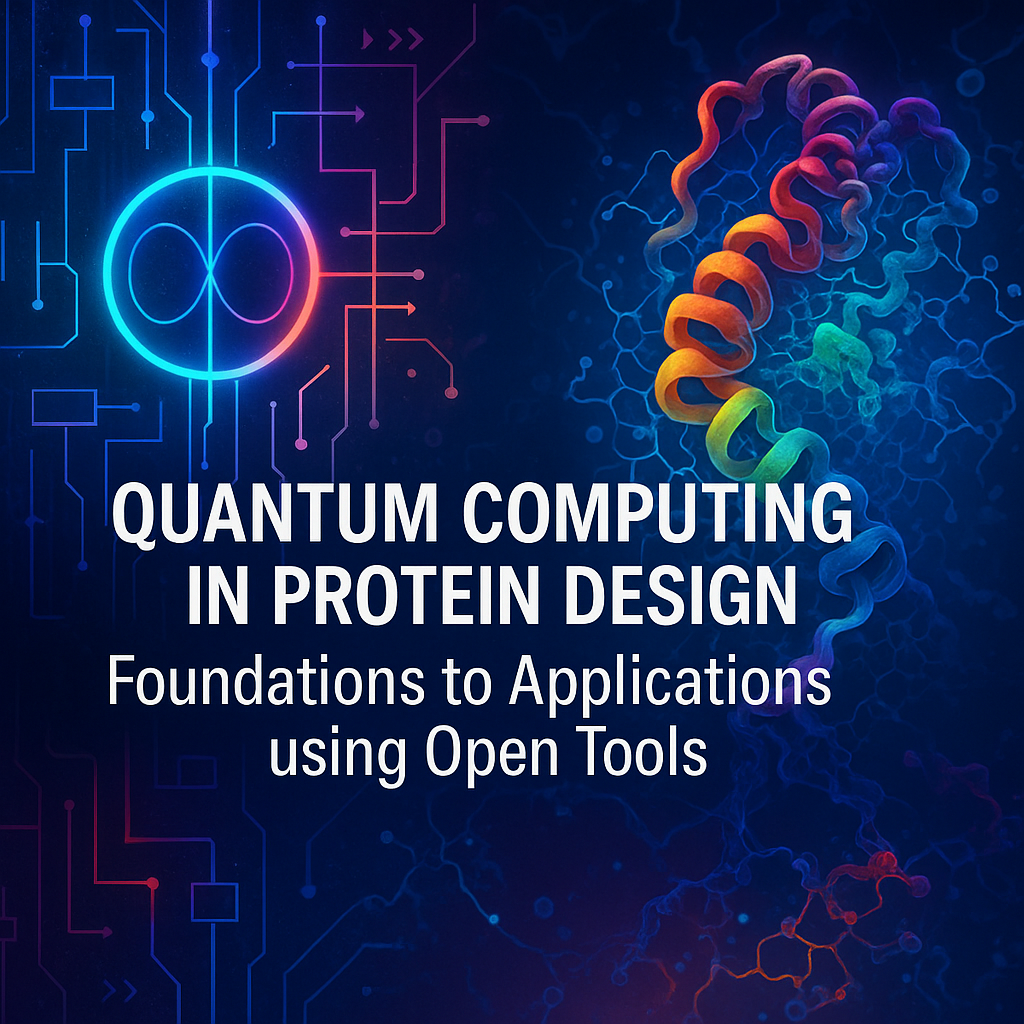
Quantum Computing in Protein Design: Foundations to Applications using Open Tools
Redefining Protein Engineering with Deep Quantum Technology.
Skills you will gain:
About Program:
Quantum computing has emerged as a transformative paradigm with the potential to revolutionize molecular biology and protein engineering. Protein folding — a complex, NP-hard problem — stands to benefit significantly from quantum-inspired approaches that promise more efficient and scalable solutions. This workshop is designed to bridge the gap between quantum computing theory and its real-life implications in protein science.
Over two days, participants will explore fundamental quantum computing principles, biological protein structures, and key quantum algorithms like VQE, QAOA, and quantum annealing. Through hands-on sessions using IBM Quantum Experience, D-Wave Leap, and frameworks like PennyLane, learners will simulate protein folding and apply quantum machine learning models to biological datasets — all using free, open-source tools.
Aim:
To introduce participants to the interdisciplinary fusion of quantum computing and protein design, equipping them with the foundational concepts and hands-on skills using open-source quantum tools. The workshop enables learners to understand protein folding, quantum algorithms, and their real-world biological applications.
Program Objectives:
-
Understand quantum computing principles and their application to biological systems
-
Learn the fundamentals of protein structure and folding problems
-
Apply quantum algorithms like VQE and QAOA to biomolecular challenges
-
Gain hands-on experience with IBM Quantum and D-Wave platforms
-
Build simple QML models to analyze protein-based datasets using open-source tools
What you will learn?
Day 1: Foundations of Quantum Biology and Protein Folding
- Introduction to Quantum Computing
• Qubits, superposition, entanglement
• Classical vs quantum computing - Primer on Protein Structure and Design
• Primary to quaternary structures
• Protein folding problem - Challenges in Protein Folding
• Energy landscapes
• NP-hard nature of folding - Quantum Algorithms in Biology
• VQE and QAOA explained with relevance to molecular systems - Hands-on Demo with IBM Quantum Experience
• Create account
• Visualize gates and run basic circuits
Day 2: Quantum Applications for Protein Design and Learning
- Quantum Annealing & Protein Folding
• Lattice models (e.g., HP)
• QUBO formulation and quantum annealers - Hands-on with D-Wave Leap
• Environment setup
• Run protein folding example via Ocean SDK / Leap IDE - Quantum Machine Learning (QML)
• Frameworks: PennyLane, Qiskit ML
• Applications in protein-ligand interactions - Protein Feature Classification with QML
• Preprocessing data
• Building a QNN in PennyLane - Future of Quantum Protein Design
• Ethics, careers, and emerging research paths
Mentor Profile
Fee Plan
Get an e-Certificate of Participation!
Intended For :
- Undergraduate or postgraduate degree in Biotechnology, Bioinformatics, Physics, Computer Science, or related fields.
- Professionals in quantum computing, life sciences, pharmaceutical R&D, or computational biology sectors.
- Individuals with a strong interest in cutting-edge applications of quantum technologies in biology.
Career Supporting Skills
Program Outcomes
-
Clear understanding of protein design and quantum computation synergy
-
Practical skills in using IBM and D-Wave platforms
-
Ability to frame protein folding problems for quantum solvers
-
Introduction to real-world use cases of quantum biology
-
Hands-on experience with quantum neural networks