

Chemical Synthesis of Nanomaterials: Fundamentals and Techniques
Shaping the Future with Nano: Discover, Synthesize, and Apply!
Skills you will gain:
About Program:
Nanomaterials are revolutionizing industries ranging from medicine to electronics due to their unique properties and vast applications. The workshop “Chemical Synthesis of Nanomaterials: Fundamentals and Techniques” is designed for participants with a foundational knowledge of chemistry and materials science. It delves into the principles of nanomaterial synthesis, exploring both top-down and bottom-up approaches, and provides insights into how these materials are tailored for specific applications.
The workshop also emphasizes the relevance of nanomaterials in real-world scenarios such as catalysis, electronics, environmental sustainability, and healthcare innovations. With a balanced mix of theory, demonstrations, and interactive discussions, participants will gain both the foundational knowledge and the confidence to pursue further studies or careers in the field of nanotechnology.
Aim: To provide a comprehensive understanding of the fundamental concepts and techniques involved in the chemical synthesis of nanomaterials, exploring their properties, synthesis methods, and diverse applications across industries. This workshop aims to equip participants with knowledge to apply these techniques in research and industrial settings.
Program Objectives:
- To provide foundational knowledge of nanomaterial properties and synthesis principles.
- To introduce top-down and bottom-up synthesis methods with examples.
- To demonstrate the industrial applications of synthesized nanomaterials.
- To encourage active participation and discussion on current and future trends.
- To equip participants with skills for advanced research or industrial applications in nanotechnology.
What you will learn?
Introduction to Nanomaterials
- Definition and significance of nanomaterials.
- Overview of properties and characteristics of nanomaterials.
- Examples of commonly synthesized nanomaterials.
Chemical Synthesis Methods
- Top-Down Approaches:
- Mechanical milling
- Lithography
- Bottom-Up Approaches:
- Sol-Gel Process
- Hydrothermal Synthesis
- Chemical Vapor Deposition (CVD)
- Precipitation Method
- Comparison of methods and selection criteria
Applications of Nanomaterials
- Catalysis
- Electronics
- Medicine (e.g., drug delivery systems)
- Environmental applications
Q&A and Discussion
- Address questions from participants.
- Open discussion on future trends and research opportunities in nanomaterial synthesis.
Conclusion
- Recap of key points.
- Suggestions for further reading and research.
Mentor Profile
Fee Plan
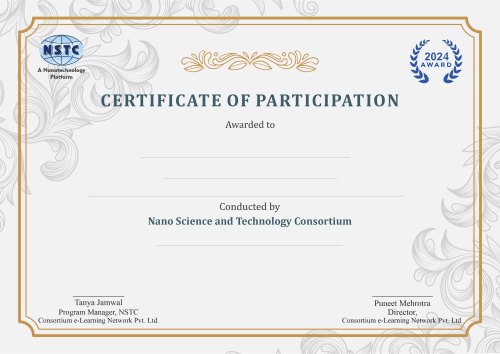
Get an e-Certificate of Participation!
Intended For :
- Undergraduate degree in Chemistry, Materials Science, Chemical Engineering, or related fields.
- Researchers or professionals in nanotechnology, materials science, or related industries.
- Individuals with a keen interest in nanomaterial synthesis and its applications.
Career Supporting Skills
Program Outcomes
- Understand the fundamental principles and techniques of nanomaterial synthesis.
- Learn to select appropriate synthesis methods for specific applications.
- Recognize the industrial significance of nanomaterials in diverse fields.
- Gain insights into current trends and future opportunities in nanotechnology.
- Develop confidence to explore further research or career paths in nanotechnology.