
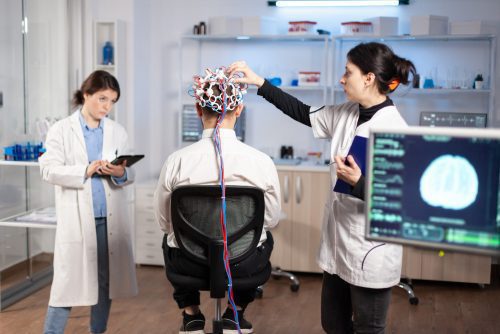
AI and Digital Technologies: Pioneering Healthcare Transformation
Transforming Healthcare with Cutting-Edge AI and Digital Technologies
Skills you will gain:
This course is designed to provide healthcare professionals with a deep understanding of how digital technologies are transforming healthcare systems, processes, and patient care.
Aim: This program covers strategic planning, implementation of digital health solutions, data analytics, and the integration of emerging technologies such as AI, IoT, and blockchain in healthcare settings.
Program Objectives:
- To understand the scope and impact of digital transformation in the healthcare industry.
- To learn about the strategic planning and execution of digital health projects.
- To gain insights into the use of data analytics and AI in improving healthcare outcomes.
- To explore the role of IoT, wearable technologies, and remote patient monitoring in enhancing patient care.
- To understand the ethical, privacy, and security considerations in digital healthcare.
- To study the implementation of blockchain technology in healthcare data management for enhanced security and interoperability.
What you will learn?
Module 1: Introduction to AI in Healthcare
- Overview of AI in Medicine: Evolution of AI in healthcare, core concepts of AI and machine learning.
- Key Digital Technologies in Healthcare: IoT, telemedicine, and wearable tech.
- AI’s Role in Healthcare Transformation: Understanding how AI drives change in patient care, hospital operations, and research.
Module 2: Data and Digital Health Infrastructure
- Healthcare Data Ecosystems: Types of healthcare data, data sources, and interoperability.
- Data Privacy and Security: HIPAA, GDPR, and key considerations for patient data protection.
- Data Cleaning and Preprocessing: Preparing healthcare data for AI applications.
Module 3: Machine Learning Applications in Diagnostics
- Supervised Learning for Diagnostic Tools: Applications in radiology, pathology, and genomics.
- Unsupervised Learning for Disease Detection: Clustering techniques for early disease detection and anomaly detection.
- Natural Language Processing (NLP) in Healthcare: Using NLP for analyzing medical records, literature, and patient feedback.
Module 4: Predictive Analytics and Patient Outcome Forecasting
- Predictive Analytics in Healthcare: Identifying trends in patient data, predicting patient outcomes.
- Time-Series Analysis for Monitoring Health: Using time-series data from wearables and medical devices.
- Risk Stratification Models: AI models for patient risk scoring and hospital readmission predictions.
Module 5: Personalized Medicine and AI-Driven Treatment Planning
- Precision Medicine and Genomics: AI’s role in personalized treatment, drug discovery, and genomics.
- Clinical Decision Support Systems (CDSS): AI-based tools for aiding clinical decisions.
- Real-World Applications: Case studies of personalized treatment plans and adaptive care.
Module 6: Robotics and Automation in Healthcare
- Surgical Robots and Automation: Overview of robotic surgery and automation in healthcare operations.
- AI in Robotic Process Automation (RPA): Automating administrative tasks and improving efficiency.
- Wearable and Assistive Technologies: Wearable AI devices for continuous health monitoring.
Module 7: Remote Care and Telemedicine Innovations
- Telehealth and AI: Role of AI in enhancing remote consultations, diagnostics, and treatment.
- Mobile Health (mHealth) Technologies: App-based monitoring, remote patient management.
- IoT in Healthcare: Role of connected devices in patient care and remote monitoring.
Module 8: AI Ethics, Regulation, and Patient Trust
- Ethical Considerations in AI: Fairness, accountability, and transparency in AI models.
- Regulations and Compliance: Key regulations governing AI in healthcare (FDA, EMA).
- Building Trust with AI in Healthcare: Importance of transparency and patient-centered AI applications.
Module 9: Emerging Trends and Future of AI in Healthcare
- Blockchain for Secure Data Sharing: Using blockchain for interoperability and secure patient records.
- Augmented Reality (AR) and Virtual Reality (VR) in Healthcare: Applications in training, diagnostics, and treatment.
- Quantum Computing in Drug Discovery and Healthcare: Potential applications of quantum computing in AI healthcare.
Module 10: Capstone Project and Industry Case Studies
- Industry Case Studies: Reviewing successful AI implementations in healthcare (e.g., IBM Watson, Google Health).
- Capstone Project: Development and presentation of a healthcare AI solution, applying course learnings.
Intended For :
- Healthcare Professionals: Doctors, nurses, and healthcare administrators looking to integrate AI and digital technologies into their practices.
- IT Professionals: Developers, data scientists, and IT managers interested in applying their skills to the healthcare sector.
- Students and Researchers: Individuals in healthcare, computer science, and related fields aiming to specialize in healthcare technology.
- Business Leaders: Executives and managers in healthcare organizations seeking to understand the impact and implementation of digital transformation.
Career Supporting Skills