

AI-Powered Biosensors for Precision Diagnostics: Nanomaterials, Machine Learning & Point-of-Care Testing
From Nanomaterials to Intelligent Diagnostics — Design, Analyse and Optimise AI-Enabled Biosensors for Rapid Point-of-Care Testing.
Skills you will gain:
About Workshop:
This 3-day mentor-led workshop introduces the principles and applications of nanomaterial-based biosensors, machine learning, and point-of-care (POC) diagnostics. Participants will explore sensor design, nanomaterial-enabled signal enhancement, biomarker detection, biosensor data analysis, and AI-based prediction and classification. The workshop follows a practical workflow from biosensor design and experimental data to machine-learning analysis and intelligent diagnostic decision-making.
Aim: To provide practical, research-oriented training in nanomaterial-based biosensor design, sensor-data analysis, machine learning, and point-of-care diagnostic applications for biomedical and healthcare research.
Workshop Objectives:
Workshop Objectives
Participants will learn to:
- Understand biosensor principles and major biosensor architectures.
- Explore nanomaterials used for enhanced sensing and signal transduction.
- Understand nanomaterial–biomolecule interactions and surface functionalisation.
- Explore electrochemical, optical, and other biosensing approaches.
- Understand biomarker selection and diagnostic assay design.
- Analyse sensor response, sensitivity, selectivity, and detection limits.
- Process and visualise biosensor datasets.
- Develop machine-learning features from sensor signals.
- Apply classification and regression models to biosensor data.
- Evaluate model performance using appropriate statistical metrics.
- Apply explainable AI to understand important sensor features.
- Explore AI-assisted disease classification and diagnostic prediction.
- Understand POC device design, miniaturisation, and real-world constraints.
- Evaluate reproducibility, validation, and translational considerations.
📅 3-Day Workshop Structure
1.5 Hours/Day | Mentor-Based Virtual Workshop
What you will learn?
Day 1: Nanomaterial-Based Biosensors & Diagnostic Signal Analysis
Focus: Understand biosensor design, nanomaterials, biomarker detection, and sensor-response characteristics.
Topics Covered
- Fundamentals of biosensors and precision diagnostics
- Biosensor components: bioreceptor, transducer, signal-processing system
- Electrochemical, optical, and other biosensing platforms
- Nanomaterials for enhanced biosensing
- Gold nanoparticles, silver nanoparticles, graphene, carbon nanotubes, and metal oxides
- Nanomaterial surface functionalisation and biomolecule immobilisation
- Biomarker recognition and assay design
- Sensitivity, selectivity, limit of detection, response time, and dynamic range
- Sensor calibration and response curves
- Sources of noise, interference, and experimental variability
Hands-on:Analyse a curated biosensor dataset, generate calibration curves, calculate analytical performance parameters, and compare sensor responses.
Workflow:
Nanomaterial → Bioreceptor → Sensor Response → Signal Processing → Diagnostic Performance
Tools Covered
Python, pandas, NumPy, matplotlib, Google Colab, curated biosensor datasets
Day 2: Machine Learning for Biosensor Data & Diagnostic Prediction
Focus: Transform sensor signals and experimental parameters into predictive machine-learning models.
Topics Covered
- Biosensor dataset development and data preprocessing
- Signal cleaning, normalization, and feature extraction
- Sensor-response and biomarker features
- Exploratory data analysis and correlation analysis
- Classification and regression approaches for biosensor data
- Random Forest and XGBoost models
- Training, testing, and cross-validation
- Performance metrics: accuracy, precision, recall, F1-score, ROC-AUC, MAE, and RMSE
- Feature importance and sensor-variable selection
- Explainable AI for diagnostic predictions
Hands-on:Build and evaluate a machine-learning model using biosensor data to classify diagnostic conditions or predict biomarker concentrations.
Workflow:
Sensor Data → Preprocessing → Feature Engineering → ML Model → Validation → Diagnostic Prediction
Tools Covered
Python, pandas, NumPy, scikit-learn, Random Forest, XGBoost, matplotlib, Google Colab
Day 3: AI-Enabled Point-of-Care Diagnostics & Sensor Optimisation
Focus: Integrate biosensor technology and AI for rapid, portable, and data-driven diagnostic applications.
Topics Covered
- Principles of point-of-care diagnostic systems
- Portable and miniaturised biosensor platforms
- Integration of sensors, data acquisition, and AI models
- Multiplexed biomarker detection
- AI-assisted disease classification and risk prediction
- Sensor optimisation using data-driven approaches
- Multi-parameter optimisation of sensitivity, selectivity, response time, and stability
- Candidate sensor comparison and performance ranking
- Explainable diagnostic decision-making
- Validation, reproducibility, and generalisation
- POC challenges: matrix effects, calibration, robustness, and usability
- Translational and regulatory considerations
Hands-on:Screen biosensor designs, apply an ML model for diagnostic prediction, identify important sensor parameters, and develop a prioritised POC biosensor configuration.
Workflow:
Sensor Dataset → AI Prediction → Feature Interpretation → Optimisation → Sensor Ranking → POC Application
Tools Covered
Python, scikit-learn, XGBoost, SHAP, pandas, Plotly, Google Colab
Mentor Profile
Fee Plan
Important Dates
20 Nov 2026 Indian Standard Timing
20 Nov 2026 to 22 Nov 2026 Indian Standard Timing 5:30PM
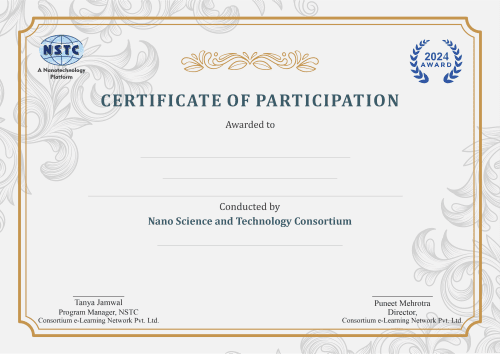
Get an e-Certificate of Participation!
Intended For :
Who Should Enrol?
- Graduate & Postgraduate Students – Biotechnology, Biomedical Engineering, Nanotechnology, Bioengineering, Biochemistry, Chemistry, Pharmacy, Bioinformatics, Life Sciences, and related disciplines.
- PhD Scholars & Researchers – Working in biosensors, nanobiosensors, diagnostics, nanomaterials, biomedical engineering, biomarker research, AI/ML, and healthcare technologies.
- Academicians & Faculty Members – Interested in biosensor technology, nanomedicine, computational diagnostics, and AI-enabled healthcare research.
- Industry Professionals – From medical diagnostics, biotechnology, pharmaceutical R&D, healthcare technology, biosensor development, nanotechnology, and point-of-care device industries.
- Data Science & AI Researchers – Interested in applying machine learning to biomedical sensor data and diagnostic applications.
Career Supporting Skills
Workshop Outcomes
Workshop Outcomes
- Explain fundamental biosensor and nanobiosensor principles.
- Understand the role of nanomaterials in signal enhancement and biomarker detection.
- Compare major biosensing and transduction approaches.
- Analyse sensor-response and calibration data.
- Calculate key analytical performance parameters.
- Develop and preprocess biosensor datasets.
- Extract useful features from sensor measurements.
- Build and evaluate ML models for diagnostic prediction.
- Apply Random Forest and XGBoost to biosensor datasets.
- Interpret predictions using explainable AI.
- Identify important sensor and biomarker features.
- Optimise biosensor performance using data-driven approaches.
- Understand the design principles and challenges of POC diagnostics.