

3D-Printed Bio-Inspired Lattices: Lightweight Design, Strength & Energy Absorption
Design lightweight 3D-printed structures inspired by nature—and explore how their geometry affects strength and energy absorption.
Skills you will gain:
About Workshop:
This three-day workshop explores bio-inspired lattice engineering through biomimicry, computational design, mechanical simulation and additive manufacturing. Participants will learn about advanced lattice architectures, including TPMS, Gyroid, Diamond and functionally graded structures, along with their mechanical properties, energy absorption and engineering applications.
Aim:
To provide participants with fundamental and applied knowledge of bio-inspired lattice engineering by integrating biomimicry, computational design, mechanical simulation, structural optimization and additive manufacturing for developing lightweight structures with enhanced mechanical performance and energy absorption capabilities.
Workshop Objectives:
Participants will learn to:
- Understand biomimicry and biological structural designs.
- Explore conventional and advanced lattice architectures.
- Learn CAD modelling and computational lattice generation.
- Understand mechanical simulation and structural optimization.
- Explore energy absorption and mechanical performance.
- Learn additive manufacturing and design for 3D printing.
- Introduce experimental testing and engineering applications.
What you will learn?
Day 1: Fundamentals of Bio-Inspired Lattice Design
- Introduction to biomimicry and bio-inspired engineering.
- Biological inspiration: bone, bamboo, honeycomb, and nacre structures.
- Fundamentals of lattice architectures: BCC, FCC, TPMS, Gyroid, Diamond, and Voronoi structures.
- Functionally graded, hierarchical and multiscale lattice designs.
- Understanding porosity, relative density, stiffness, and structural efficiency.
- Hands-on Practical: Design and modelling of bone-inspired and gyroid lattice structures using CAD and computational design tools.
Tools: Fusion 360, nTop and ImageJ.
Day 2: Computational Design, Mechanical Simulation and Optimization
- Parametric and computational lattice modelling.
- Advanced TPMS and functionally graded lattice generation.
- Introduction to Finite Element Analysis (FEA).
- Material properties, meshing, loading conditions, and boundary conditions.
- Stress, strain, deformation and compression behaviour.
- Mechanical performance evaluation and energy absorption mechanisms.
- Topology optimization and structural performance improvement.
- Hands-on Practical: Computational simulation of lattice structures under compression loading, including stress distribution, deformation analysis and performance comparison.
Tools: nTop, Fusion 360, ANSYS Workbench and Microsoft Excel.
Day 3: Additive Manufacturing, Mechanical Testing and Applications
- Fundamentals of additive manufacturing: FDM, SLA, SLS, and SLM/LPBF.
- Materials selection and manufacturing considerations.
- Design for Additive Manufacturing (DfAM).
- STL/3MF preparation, slicing and print parameter optimization.
- Mechanical characterization of lattice structures through compression testing.
- Stress-strain analysis, stiffness, deformation, and energy absorption.
- Experimental versus computational validation.
- Biomedical, aerospace, automotive, and lightweight engineering applications.
- Hands-on Practical: Preparation of lattice structures for 3D printing, slicing parameter configuration, and analysis of compression testing datasets.
Tools: Fusion 360, Ultimaker Cura, PrusaSlicer, Universal Testing Machine (UTM), OriginPro, and Microsoft Excel.
Mentor Profile
Fee Plan
Important Dates
18 Nov 2026 Indian Standard Timing 4:30 PM
16 Nov 2026 to 18 Nov 2026 Indian Standard Timing 5:00 PM
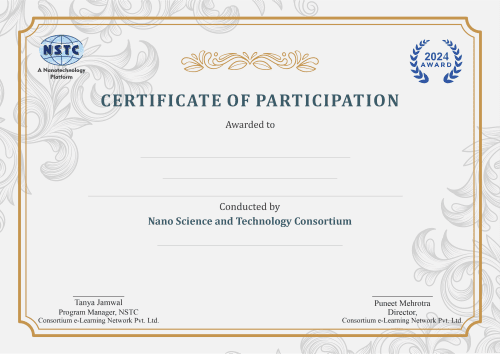
Get an e-Certificate of Participation!
Intended For :
- Undergraduate and postgraduate students in mechanical, materials, manufacturing, aerospace, biomedical, or related fields
- Researchers and educators working in engineering design or additive manufacturing
- Professionals in product design, 3D printing, or lightweight structures
Career Supporting Skills
Workshop Outcomes
- Explain how natural structures inspire lightweight lattice designs.
- Identify and compare common lattice geometries, including honeycomb, diamond, octet, and gyroid.
- Create a basic bio-inspired lattice model using CAD software.
- Adjust design features such as cell size, thickness, and orientation.
- Interpret basic compression or simulation results.
- Compare lattice designs using weight, stiffness, strength, and energy-absorption measures.
- Check and prepare a lattice model for 3D printing.
- Present a design concept with a clear explanation of its predicted performance and limitations.