

Photoelectrocatalysis for Green Hydrogen: Materials & Reactor Design
From Advanced Photoelectrode Materials to Scalable Green Hydrogen Reactor Systems
Skills you will gain:
About Workshop:
This workshop provides a structured introduction to photoelectrocatalysis for green hydrogen production, progressing from semiconductor materials and photoelectrode design to electrochemical characterization, reactor engineering, and techno-economic analysis.
Participants will explore key concepts such as bandgap engineering, heterojunctions, charge-transfer kinetics, PEC performance analysis, reactor transport phenomena, and hydrogen production economics. The workshop also includes Google Colab-based hands-on activities for material screening, electrochemical data analysis, and photoreactor simulation.
Aim: The workshop aims to build a practical and research-oriented understanding of how photoelectrocatalytic materials, electrochemical processes, and reactor design can be integrated to develop efficient and scalable green hydrogen systems.
Workshop Objectives:
- Understand the fundamentals of photoelectrochemical water splitting and green hydrogen generation.
- Explore semiconductor materials, band engineering, heterojunctions, and catalyst modification strategies.
- Analyze PEC performance using LSV, IPCE, ABPE, EIS, Mott-Schottky, and related techniques.
- Understand charge transport, recombination, and reaction kinetics in photoelectrodes.
- Explore photoreactor design, light management, mass transport, and gas evolution challenges.
- Introduce computational material screening and data-driven analysis using Python.
- Evaluate scale-up potential using Techno-Economic Analysis and Levelized Cost of Hydrogen.
What you will learn?
🗓️ Day 1: Fundamentals, Materials Design & Catalyst Screening
- Objective: Understand the fundamentals of photoelectrocatalysis and explore materials engineering strategies for efficient solar-driven water splitting.
- Fundamentals of photoelectrocatalysis and photoelectrochemical water splitting.
- Semiconductor photoelectrodes: light absorption, charge generation, separation, and recombination.
- HER and OER fundamentals with Solar-to-Hydrogen (STH) efficiency concepts.
- Band structure and bandgap engineering of BiVO₄, α-Fe₂O₃, TiO₂, and Cu₂O.
- Heterojunction engineering: Type-II, S-scheme, and Z-scheme architectures.
- Defect engineering, doping, co-catalysts, and surface passivation strategies.
- Computational and DFT-assisted screening of semiconductor materials.
🛠️ Hands-on Lab (Google Colab)
- Task: Build a Band Alignment Predictor to screen semiconductor materials and compare their band-edge positions with water redox potentials.
- Tools Covered: Python, mp-api, pymatgen, and Google Colab.
🗓️ Day 2: Photoelectrochemical Characterization & Reaction Kinetics
- Objective: Analyze photoelectrochemical performance, charge-transfer behavior, reaction kinetics, and stability using standard PEC characterization techniques.
- Photocurrent-density curves and key PEC performance parameters.
- Linear Sweep Voltammetry (LSV), IPCE, and ABPE measurements.
- Bulk charge transport, surface reaction kinetics, and recombination losses.
- Electrochemical Impedance Spectroscopy (EIS) and charge-transfer resistance analysis.
- Mott-Schottky analysis for flat-band potential and carrier density.
- IMPS for studying charge-transfer and recombination dynamics.
- Photoelectrode stability, photocorrosion, and degradation analysis.
🛠️ Hands-on Lab (Google Colab)
- Task: Develop an EIS & Mott-Schottky Data Fitting Engine to fit electrochemical datasets, estimate key parameters, and generate PEC performance plots.
- Tools Covered: Python, impedance.py, SciPy, Matplotlib, and Google Colab.
🗓️ Day 3: Reactor Engineering, Scale-Up & Techno-Economic Analysis
- Objective: Design scalable photoelectrochemical reactor systems and evaluate their engineering performance, durability, and commercial feasibility.
- Photoelectrochemical reactor architectures: planar, panel-type, and microfluidic systems.
- Light absorption, photon transport, and Beer-Lambert attenuation in photoreactors.
- Mass transport, fluid flow, and electrochemical reaction coupling.
- Hydrogen and oxygen bubble dynamics and their impact on reactor efficiency.
- Membrane separation, gas collection, and safe H₂/O₂ management.
- Tandem photoelectrodes and zero-bias water splitting systems.
- Reactor durability, scalability, and long-term performance challenges.
- Techno-Economic Analysis (TEA), Levelized Cost of Hydrogen (LCOH), and commercial viability.
🛠️ Hands-on Lab (Google Colab)
- Task: Build a Photoreactor Light & Mass-Transport Simulator to model photon flux, concentration profiles, transport behavior, and overall reactor performance.
- Tools Covered: Python, NumPy, SciPy, Plotly, and Google Colab.
Mentor Profile
Fee Plan
Important Dates
12 Nov 2026 Indian Standard Timing 4:30 PM
10 Nov 2026 to 12 Nov 2026 Indian Standard Timing 5:30 PM
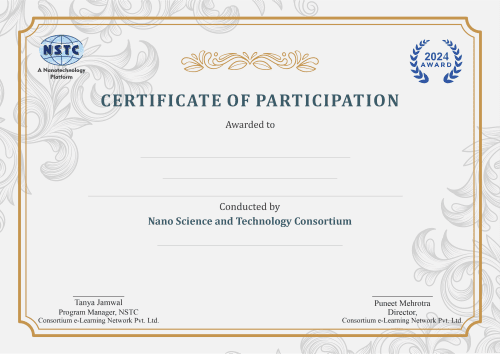
Get an e-Certificate of Participation!
Intended For :
This workshop is suitable for:
- Ph.D. Scholars and Researchers working in hydrogen energy, photocatalysis, electrochemistry, materials science, or renewable energy.
- Academicians and Faculty Members interested in emerging green hydrogen technologies and advanced photoelectrochemical systems.
- Industry Professionals and Engineers working in hydrogen production, energy systems, electrochemical technologies, materials development, and sustainability.
- R&D Professionals involved in catalyst development, reactor engineering, renewable fuels, and clean-energy technologies.
- Postgraduate Students in chemical engineering, materials science, chemistry, physics, energy engineering, and related disciplines seeking research-oriented exposure to photoelectrocatalysis.
Career Supporting Skills
Workshop Outcomes
By the end of the workshop, participants will be able to:
- Explain the working principles of photoelectrocatalytic hydrogen production.
- Compare and evaluate semiconductor materials for water-splitting applications.
- Interpret common photoelectrochemical characterization data.
- Analyze charge-transfer resistance, flat-band potential, and carrier density.
- Understand key design parameters influencing PEC reactor performance.
- Model basic light attenuation and mass-transport behavior in photoreactors.
- Assess efficiency, stability, scalability, and economic feasibility of green hydrogen systems.
- Apply Python-based computational tools for material screening and PEC data analysis.