

Green Nanotechnology: Sustainable Materials, AI, and LCA
Advancing Sustainable Nanotechnology Through Innovation and Practical Learning.
Skills you will gain:
About Program:
Green nanotechnology integrates nanoscience with environmental sustainability to develop safe, non-toxic, and energy-efficient materials and processes. It emphasizes the use of renewable resources, plant-based synthesis routes, and waste minimization techniques in nanomaterial production.
This short-duration workshop introduces participants to sustainable nanomaterial design, green synthesis methods, environmental remediation applications, and lifecycle considerations of nanomaterials. It also includes simulation-based hands-on learning for green synthesis and environmental applications.
Aim: This intensive workshop is designed to equip you with the practical skills to design, synthesize, and evaluate green nanomaterials for environmental and energy applications
Program Objectives:
-
Design a Green Synthesis Protocol: Develop a step-by-step plan for synthesizing nanoparticles using plant-based or biological resources, justifying your choice of parameters (pH, temperature, concentration) for optimal stability and yield.
-
Perform a Comparative Synthesis Analysis: Critically evaluate and contrast the environmental and economic trade-offs between conventional chemical synthesis and green synthesis routes for a given nanomaterial application.
-
Simulate and Optimize a Water Filtration System: Build and test a virtual nanomaterial-enabled filtration model, analyzing its efficiency in removing specific pollutants and adjusting parameters to improve performance.
-
Evaluate Pollutant Adsorption Efficiency: Quantify and compare the adsorption capacity of different green nanomaterials using computational tools, generating data to support material selection for air or soil remediation projects.
-
Apply a Life Cycle Assessment (LCA) Framework: Conduct a mini-LCA to evaluate the environmental footprint of a nanomaterial, from raw material sourcing to end-of-life, identifying key areas for sustainable design improvements.
-
Select Sustainable Materials for Energy Applications: Use an AI-assisted simulation tool to screen and select the most appropriate green nanomaterials for renewable energy systems like solar cells or batteries, based on performance and sustainability criteria.
-
Communicate Sustainable Innovation: Prepare a concise, data-backed report or presentation that clearly articulates the sustainability benefits and performance metrics of a green nanomaterial solution for a real-world challenge.
What you will learn?
Mentor Profile
Fee Plan
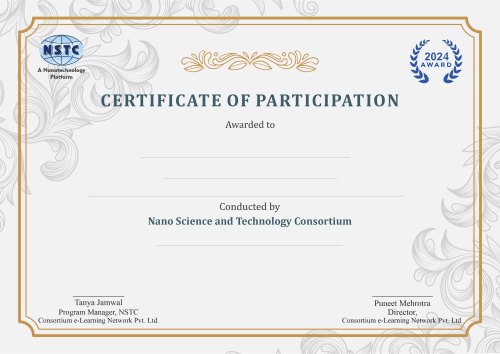
Get an e-Certificate of Participation!
Intended For :
This workshop is tailored for a diverse global cohort spanning academia and industry, welcoming undergraduate and postgraduate students from fields such as nanotechnology, biotechnology, environmental science, chemistry, physics, and engineering. It serves as an advanced platform for Ph.D. scholars, researchers, faculty members, and academicians seeking to deepen their expertise, while simultaneously providing high-value insights for industry professionals working within the sustainability, materials science, and energy sectors. Additionally, the curriculum is structured to accommodate ambitious beginners and newcomers who are eager to establish a foundational understanding of emerging green technologies.
Career Supporting Skills
Program Outcomes
- Understand principles of green nanotechnology
- Identify eco-friendly nanomaterial synthesis methods
- Analyze environmental applications of nanotechnology
- Evaluate sustainability of nanomaterials
- Explore renewable energy and pollution control solutions
- Apply green science concepts in research and innovation