

AI-Driven Design of Nanomaterials for Energy Storage
AI-Powered Nanomaterials for Smarter, Safer, and Sustainable Energy Storage
Skills you will gain:
About Program:
This workshop focuses on how Artificial Intelligence can accelerate the discovery, design, and optimization of nanomaterials for advanced energy storage applications. Participants will explore how AI, machine learning, and data-driven modeling can support the development of high-performance materials for batteries, supercapacitors, and next-generation sustainable energy technologies.
Aim: The aim of this workshop is to provide participants with a practical understanding of how AI-driven approaches can be used to design and analyze nanomaterials for efficient, reliable, and sustainable energy storage systems.
Program Objectives:
- To introduce the role of nanomaterials in modern energy storage technologies.
- To explain how AI and machine learning can support material discovery and performance prediction.
- To help participants understand data-driven methods for analyzing material properties.
- To explore applications of AI-designed nanomaterials in batteries, supercapacitors, and clean energy systems.
- To provide insights into current research trends and future opportunities in AI-enabled materials science.
What you will learn?
📅 Day 1: Foundations of AI-Driven Nanomaterials for Energy Storage
- Introduction to nanomaterials for energy storage applications
- Role of nanomaterials in batteries, supercapacitors, and next-generation energy devices
- Key material properties: surface area, conductivity, porosity, particle size, and stability
- Importance of AI in nanomaterial discovery and design
- Basics of materials informatics and data-driven materials research
- Understanding MDPI-based research trends in nanomaterials and energy storage
🛠️ Hands-on Activity:
Research Trend Mining from Nanomaterials Literature Using Python
Participants will use Python in Google Colab to analyze sample MDPI-inspired research data, clean article titles and keywords, extract trending research terms, and visualize major themes using word clouds and frequency plots.
📅 Day 2: Machine Learning for Nanomaterial Property Prediction
- Machine learning for nanomaterial performance prediction
- Understanding material datasets: composition, synthesis conditions, structure, and performance values
- Important input features: surface area, pore size, conductivity, synthesis temperature, and material type
- Predicting battery capacity, specific capacitance, energy density, and cycle stability
- Regression models for material property prediction
- Model evaluation using MAE, RMSE, and R² score
🛠️ Hands-on Activity:
Predicting Energy Storage Performance of Nanomaterials
Participants will build a simple machine learning model in Google Colab to predict specific capacitance or battery capacity using sample nanomaterial features such as surface area, conductivity, pore size, and synthesis temperature.
📅 Day 3: AI-Based Material Screening, Optimization, and Future Research Directions
- AI-based screening of candidate nanomaterials for batteries and supercapacitors
- Ranking materials based on performance, stability, cost, sustainability, and scalability
- Explainable AI for understanding important material features
- AI-assisted optimization of nanomaterial design and synthesis conditions
- Use of Generative AI and LLMs for literature analysis and research planning
- Future trends: autonomous materials discovery, smart laboratories, digital twins, and AI-guided synthesis
🛠️ Hands-on Activity:
AI-Based Screening and Ranking of Nanomaterials
Participants will create a Google Colab notebook to rank candidate nanomaterials using performance, conductivity, stability, cost, and sustainability parameters, and generate a final ranked list of suitable materials for energy storage applications.
Mentor Profile
Fee Plan
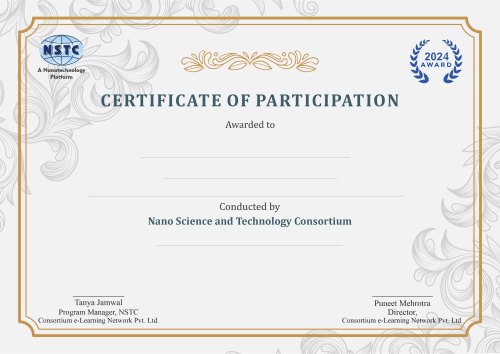
Get an e-Certificate of Participation!
Intended For :
Career Supporting Skills
Program Outcomes
- Understand the fundamentals of nanomaterials used in energy storage.
- Explain the importance of AI in accelerating nanomaterial design and optimization.
- Identify key material properties that influence battery and supercapacitor performance.
- Understand how machine learning models can be applied for material screening and prediction.
- Recognize real-world applications of AI-driven nanomaterials in sustainable energy storage.
- Gain awareness of emerging research directions in AI, nanotechnology, and energy materials.