

LCA Dashboards for Emerging Tech: Quantifying Biotech & Nanotech Sustainability
From Lab Metrics to Interactive Sustainability Dashboards
Skills you will gain:
About Program:
Explore the intersection of sustainability, biotechnology, and nanotechnology in this immersive 3-day workshop. Learn to build interactive LCA dashboards that turn complex environmental, social, and cost data into clear, actionable insights. Gain practical skills in handling unscaled lab metrics, synthesizing multi-dimensional datasets, and designing user-friendly interfaces for research, funding proposals, or investor presentations. Hands-on exercises with openLCA, SimaPro, Python, Streamlit, Plotly Dash, and Figma/Miro will prepare you to visualize and communicate sustainability performance effectively, empowering informed decision-making in emerging technologies.
Aim:
This workshop is designed to help participants develop practical skills in creating interactive dashboards that measure the sustainability impacts of emerging biotech and nanotech technologies. Attendees will learn to manage complex life cycle assessment (LCA) datasets, address gaps in data, and design intuitive visualization tools. The program provides hands-on experience in full-stack dashboard development, integrating environmental, social, and economic metrics. Participants will gain applied knowledge in data modeling, synthesis, and cloud deployment to support informed decision-making in research, commercialization, and policy contexts.
Program Objectives:
- Understand bottlenecks and challenges in scaling biotech and nanotech LCA.
- Learn to synthesize environmental, social, and cost data for life cycle assessment.
- Build intuitive dashboards that communicate complex sustainability metrics effectively.
- Deploy interactive dashboards using Python, Streamlit, and Plotly Dash.
- Present sustainability insights to diverse stakeholders, including investors and research committees.
What you will learn?
📅 Day 1: The Bio-Nano LCA Bottleneck & Data Architecture
- Core Objective: Learn how to quantify early-stage bio/nano technologies, handle data gaps, and build reliable baseline models for life cycle assessment.
- Why lab-scale bio/nano metrics often distort commercial-scale environmental footprints
- Defining functional baselines for complex systems such as 1 kg nano-cellulose vs. 1 batch CRISPR biocatalysts
- Managing co-products, intensive energy inputs, and nanomaterial toxicity data gaps
- Using ecoinvent and Agri-footprint datasets for bio-based input modeling
- Quantifying environmental impacts for synthetic biology and nanoparticle synthesis workflows
🛠️ Hands-on:
- Hands-on Lab: Build a baseline LCA model for a bio/nano-material system and map key data gaps, assumptions, and impact categories.
🧰 Tools Covered: openLCA, SimaPro, ecoinvent, Agri-footprint
📅 Day 2: Data Synthesis & Dashboard UI Architecture
- Core Objective: Transform backend LCA outputs into clean, decision-ready datasets and design intuitive dashboard interfaces for non-technical stakeholders.
- Exporting raw impact categories such as GWP, acidification, and toxicity into clean data formats
- Merging environmental LCA, Social LCA, and Life Cycle Costing (LCC) into integrated datasets
- Understanding why dense spreadsheets fail in executive boardrooms and grant panels
- Designing immediate visual hierarchies for policy, investment, and research decision-making
- Structuring dashboard layouts for clarity, comparison, and stakeholder engagement
🛠️ Hands-on:
- Hands-on Lab: Clean and structure exported LCA impact data using Python, then design a dashboard wireframe for stakeholder presentation.
🧰 Tools Covered: Python, Pandas, Figma, Miro
📅 Day 3: Deploying the Interactive Web Dashboard
- Core Objective: Build and deploy an interactive LCA dashboard that enables real-time scenario comparison, stakeholder communication, and sustainability pitching.
- Coding real-time parameter toggles for scenario testing, such as switching grid electricity to 50% solar energy
- Creating live comparison fields to benchmark nano/bio-materials against traditional materials and assets
- Hosting dashboards through secure web servers for clients, journals, or public-facing reports
- Presenting dashboard metrics for venture capital, international research grants, and sustainability reporting
- Communicating complex LCA insights through interactive visuals and simplified executive summaries
🛠️ Hands-on:
- Hands-on Lab: Develop and deploy an interactive web dashboard with scenario toggles, material comparison fields, and stakeholder-ready visual outputs.
🧰 Tools Covered: Python, Streamlit, Plotly Dash
Mentor Profile
Fee Plan
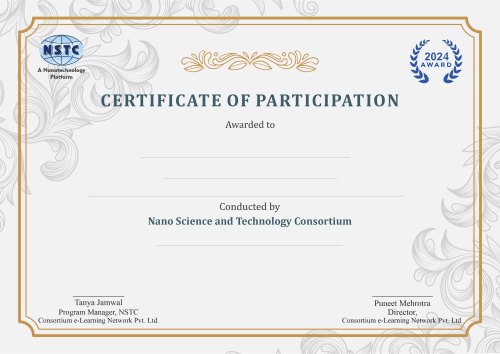
Get an e-Certificate of Participation!
Intended For :
- Undergraduate/postgraduate degree in Biotechnology, Nanotechnology, Environmental Science, Bioengineering, or related fields.
- Professionals in healthcare, pharma, nanotech, sustainability, or research sectors.
- Data scientists and AI/ML engineers interested in applying their skills to sustainability modeling.
- Individuals with a keen interest in life cycle assessment, emerging technologies, and interactive data visualization.
Career Supporting Skills
Program Outcomes
- Quantify environmental and social impacts of emerging biotech and nanotech technologies.
- Handle unscaled lab metrics and define appropriate LCA baselines.
- Synthesize multi-dimensional LCA datasets for dashboard visualization.
- Build and deploy interactive dashboards with real-time parameter adjustments.
- Communicate sustainability insights effectively to research, investors, and policy stakeholders.