
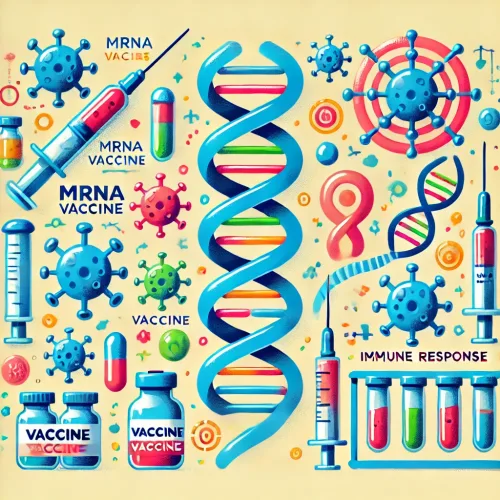
mRNA Vaccines: Development and Implementation Course
USD $59.00
This program dives into the science of mRNA vaccines, exploring their development, manufacturing, and implementation. Participants gain hands-on experience in vaccine technology, preparing for careers in biotechnology and public health.
Aim
This course provides a clear, end-to-end understanding of mRNA vaccines—from design and manufacturing to quality testing, clinical evaluation, and real-world rollout. Participants will learn how mRNA vaccines generate immune responses, how antigen sequences are chosen, how lipid nanoparticles (LNPs) deliver mRNA, what critical quality attributes (CQAs) must be controlled, and how implementation works at scale (cold chain, safety monitoring, and public communication). The course ends with a capstone plan focused on developing or deploying an mRNA vaccine for a realistic scenario.
Program Objectives
- Understand mRNA Vaccine Biology: Learn how mRNA leads to antigen expression and immune activation.
- Design the Vaccine Conceptually: Antigen selection, sequence design, and stability considerations.
- Delivery & Formulation: Understand LNP delivery, formulation choices, and how they affect performance.
- Manufacturing & QC Thinking: Learn key steps, CQAs, and testing concepts for product consistency.
- Clinical & Safety Evaluation: Understand trial phases, endpoints, and safety monitoring workflows.
- Implementation at Scale: Cold chain planning, rollout strategies, and vaccine confidence communication.
- Hands-on Outcome: Build an mRNA vaccine development or implementation blueprint as the final project.
Program Structure
Module 1: Why mRNA Vaccines Changed the Game
- How vaccine platforms differ: inactivated, subunit, viral vector, mRNA (overview).
- What mRNA vaccines do inside the body: antigen expression and immune priming.
- Speed and adaptability: why sequence-based platforms scale fast.
- Limitations: stability, storage, equity, and manufacturing constraints.
Module 2: mRNA Biology Essentials for Vaccine Design
- mRNA structure: 5’ cap, UTRs, coding region, poly(A) tail.
- Translation and antigen presentation: MHC I/II pathway concept.
- Innate immune sensing: how mRNA triggers immune pathways (and why modification helps).
- Self-amplifying RNA (saRNA) concept and how it differs from standard mRNA.
Module 3: Antigen Selection & Sequence Design
- Choosing the antigen: protective epitopes, conserved regions, variant risks.
- Sequence optimization: codon optimization and expression efficiency (concept).
- Stabilizing antigens (concept): structure-guided antigen engineering overview.
- Designing for variants: multivalent and updated-sequence strategies.
Module 4: In Vitro Transcription (IVT) & Manufacturing Workflow
- Core production steps: template DNA → IVT → capping → purification.
- Removing impurities: dsRNA and residuals (why purity matters).
- Scale-up considerations: yield, consistency, contamination control.
- GMP mindset: documentation, batch records, and change control basics.
Module 5: Delivery Systems & LNP Formulation
- Why delivery is essential: protecting mRNA and enabling cell uptake.
- LNP components overview: ionizable lipid, cholesterol, phospholipid, PEG-lipid.
- Formulation parameters: particle size, encapsulation efficiency, stability (concept).
- Administration routes and biodistribution considerations (overview).
Module 6: Quality Control, CQAs & Release Testing (Conceptual + Practical)
- Critical quality attributes (CQAs): identity, purity, potency, safety, stability.
- Typical tests overview: RNA integrity, endotoxin, sterility, particle size, encapsulation.
- Potency concepts: expression-based assays and immune readouts (overview).
- Stability studies: storage conditions and shelf-life logic.
Module 7: Preclinical Evaluation & Immunogenicity
- Preclinical goals: safety signals and immune response profiling.
- Neutralizing antibodies and T-cell responses: what matters and why.
- Dose finding and boosting strategies (overview).
- Translational caution: animal-to-human differences and realistic interpretation.
Module 8: Clinical Development & Safety Monitoring
- Clinical trial phases: Phase I/II/III and endpoints (immunogenicity, efficacy, safety).
- Adverse event monitoring: short-term AEs vs rare events (PV basics).
- Regulatory decision logic: benefit-risk assessment and evidence strength.
- Post-authorization surveillance: real-world effectiveness and safety signals.
Module 9: Implementation at Scale (Public Health & Operations)
- Cold chain and logistics: storage, transport, and site readiness.
- Prioritization strategies: high-risk groups, outbreak response, seasonal deployment.
- Vaccine confidence: communication, misinformation handling, trust-building.
- Equity considerations: access, affordability, and global distribution challenges.
Module 10: Future Directions of mRNA Platforms
- mRNA beyond infectious disease: cancer vaccines and personalized immunotherapy (overview).
- Combination platforms: mRNA + adjuvants, multiepitope strategies.
- Next-gen delivery: improved stability, thermostable formulations (concept).
- Manufacturing innovation: modular facilities and rapid scale-up strategies.
Final Project
- Create an mRNA Vaccine Development or Implementation Blueprint.
- Choose one track:
- Development Track: antigen choice, sequence plan, manufacturing steps, QC plan, and trial outline.
- Implementation Track: rollout plan, cold chain design, site workflow, safety monitoring, and communication strategy.
- Example projects: mRNA vaccine plan for an emerging virus, booster strategy for variants, rollout blueprint for a district-wide campaign, oncology mRNA vaccine concept for a tumor antigen.
Participant Eligibility
- UG/PG/PhD students in Biotechnology, Immunology, Microbiology, Pharmacy, Public Health, or related fields
- Researchers and professionals in vaccines, biologics, and translational R&D
- Public health and program professionals involved in immunization systems
- Anyone seeking a structured understanding of modern vaccine platforms (beginner-friendly)
Program Outcomes
- End-to-End Understanding: Know how mRNA vaccines are designed, manufactured, tested, and deployed.
- Formulation Awareness: Understand LNP delivery logic and key stability constraints.
- QC & Safety Mindset: Understand CQAs, release testing concepts, and pharmacovigilance basics.
- Implementation Readiness: Ability to plan rollout workflows and cold chain strategies.
- Portfolio Deliverable: A development or implementation blueprint you can showcase.
Program Deliverables
- Access to e-LMS: Full access to course content, case materials, and reference resources.
- Blueprint Templates: Antigen selection worksheet, manufacturing/QC checklist, rollout plan template, safety monitoring checklist.
- Case Exercises: Variant update decisions, cold chain planning scenarios, safety signal discussion activities.
- Project Guidance: Mentor support to build the final blueprint.
- Final Assessment: Certification after assignments + capstone submission.
- e-Certification and e-Marksheet: Digital credentials provided upon successful completion.
Future Career Prospects
- Vaccine R&D Support Associate
- Biologics Manufacturing & QC Associate (Entry-level)
- Clinical Research Associate (Vaccines)
- Immunization Program / Vaccine Implementation Associate
- Pharmacovigilance & Vaccine Safety Associate
Job Opportunities
- Biotech & Pharma: Vaccine discovery, process development, QC, and regulatory support teams.
- CROs: Vaccine clinical trials, data management, and safety monitoring operations.
- Public Health Systems: Immunization programs, cold chain operations, and vaccine surveillance.
- Research Institutes: Vaccine innovation, immunology, and translational biology labs.
| Category | E-LMS, E-LMS+Videos, E-LMS+Videos+Live |
|---|
Related products
-

Single Nucleotide Polymorphism (SNP) Detection and Analysis using NGS Course
USD $59.00 USD $249.00Price range: USD $59.00 through USD $249.00 Select options This product has multiple variants. The options may be chosen on the product page -
Next-Generation Sequencing Data Analysis Course
USD $59.00 USD $249.00Price range: USD $59.00 through USD $249.00 Select options This product has multiple variants. The options may be chosen on the product page -

Python for Biological Data Science: A Beginner’s Guide to Programming Course
USD $59.00 USD $249.00Price range: USD $59.00 through USD $249.00 Select options This product has multiple variants. The options may be chosen on the product page -
Protein Structure Prediction and Validation in Structural Biology Course
USD $59.00 USD $249.00Price range: USD $59.00 through USD $249.00 Select options This product has multiple variants. The options may be chosen on the product page -
Satellite Technology for Climate Monitoring and Disaster Response Course
USD $59.00 Add to cart






What You’ll Gain
- Full access to e-LMS
- Publication opportunity
- Self-assessment & final exam
- e-Certificate
Reviews
There are no reviews yet.