
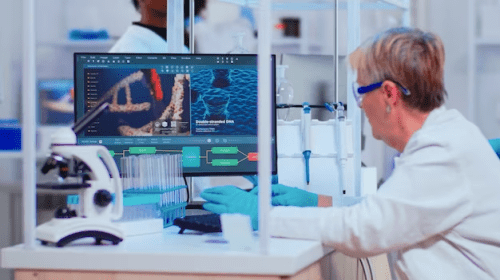
Gene Expression Analysis using R Programming
USD $59.00 USD $249.00Price range: USD $59.00 through USD $249.00
Aim: The aim of Gene Expression Analysis using R Programming is to provide participants with the necessary knowledge and skills to effectively explore, analyze, and interpret gene expression data using the R programming language. This workshop seeks to empower researchers, biologists, bioinformaticians, and students with a powerful computational toolset to gain valuable insights into the molecular basis of biological processes and diseases.
Aim
This course trains learners to perform end-to-end gene expression analysis using R—covering data cleaning, normalization, exploratory analysis, differential expression, functional enrichment, and visualization. Participants will gain hands-on experience with commonly used Bioconductor workflows and learn to interpret results in a biologically meaningful way for research and publication-ready reporting.
Program Objectives
- Build R + Bioconductor Confidence: Use R effectively for transcriptomics data analysis and reporting.
- Understand Expression Data Types: Learn microarray vs RNA-seq basics, count matrices, and metadata design.
- Run Differential Expression (DE): Perform DE analysis and interpret fold change, p-values, and FDR.
- Visualize Clearly: Generate heatmaps, volcano plots, PCA, clustering, and publication-ready figures.
- Biological Interpretation: Conduct GO/KEGG/pathway enrichment and interpret gene sets and networks.
- Hands-on Capstone: Complete a mini transcriptomics analysis project with a reproducible report.
Program Structure
Module 1: Introduction to Gene Expression Analysis
- What gene expression data tells us (and what it cannot).
- Microarray vs RNA-seq overview; counts, TPM/FPKM concepts.
- Experimental design basics: conditions, replicates, batch effects.
- What a complete analysis pipeline looks like (from raw data to biology).
Module 2: R Essentials for Transcriptomics
- Working with data frames, matrices, and metadata in R.
- Data wrangling basics (tidy workflows) and reproducible scripts.
- Reading common formats: count matrices, sample sheets, annotation tables.
- Quick plotting foundations for omics data (clean, interpretable visuals).
Module 3: Data Import, QC & Preprocessing
- Importing expression matrices and aligning sample metadata correctly.
- Quality control checks: library size, missing values, outliers.
- Filtering low-expression genes and handling noisy features.
- Batch effects and confounders: spotting them early.
Module 4: Normalization & Exploratory Data Analysis (EDA)
- Why normalization matters (and common mistakes).
- Normalization concepts for RNA-seq (e.g., size factors) and microarray (conceptual).
- Exploratory plots: PCA/MDS, sample clustering, correlation heatmaps.
- Finding patterns: grouping, separation, and troubleshooting inconsistencies.
Module 5: Differential Expression Analysis (Core Module)
- Statistical thinking: fold change, dispersion, p-values, FDR/adjusted p-values.
- Differential expression workflow using widely used R/Bioconductor methods (concept + practice).
- Design matrices and contrasts for multiple conditions.
- Interpreting results: significance vs biological relevance.
Module 6: Visualization for DE Results
- Volcano plots with meaningful thresholds and annotations.
- Heatmaps: selecting genes, scaling, clustering, and readable layouts.
- MA plots and expression distributions (before vs after normalization).
- Creating “figure-ready” outputs for reports and publications.
Module 7: Functional Enrichment & Pathway Analysis
- Gene IDs and annotation mapping (ENSEMBL, Entrez, gene symbols).
- GO enrichment (BP/CC/MF) and pathway enrichment (KEGG/Reactome concepts).
- Over-representation vs GSEA-style thinking (intro-level).
- Interpreting enrichment results without overclaiming causality.
Module 8: Advanced Topics (Optional / Add-on)
- Batch correction strategies and when to avoid them.
- Paired designs, time-series experiments, and multi-factor models.
- Basic co-expression and module discovery (intro concept).
- Best practices for reproducibility: RMarkdown / Quarto reporting workflow.
Final Project
- Analyze a real or sample gene expression dataset (RNA-seq or microarray).
- Deliver a complete workflow: QC → normalization → DE → visualization → enrichment.
- Create a reproducible report (RMarkdown/Quarto) with figures and interpretation.
- Example projects: treatment vs control response, disease vs healthy, stress response, biomarker discovery shortlist.
Participant Eligibility
- UG/PG/PhD students in Biotechnology, Genetics, Bioinformatics, Molecular Biology, or related fields
- Researchers working with transcriptomics or gene expression studies
- Life science professionals who want to learn R-based omics analysis
- Data science learners interested in biological datasets (basic biology helpful)
- Anyone aiming to build reproducible gene expression analysis skills
Program Outcomes
- End-to-End Transcriptomics Workflow: Ability to run and explain a complete gene expression analysis pipeline.
- DE Analysis Skills: Confidence in finding differentially expressed genes and interpreting statistical outputs.
- Biological Interpretation: Ability to connect DE results to pathways and gene ontology insights.
- Visualization Proficiency: Create clean, publication-ready plots and heatmaps.
- Reproducible Reporting: Generate a structured report suitable for academic submission or publications.
Program Deliverables
- Access to e-LMS: Full access to course slides, notebooks, datasets (sample), and resources.
- Hands-on Assignments: Weekly practice tasks with guided interpretation steps.
- Project Guidance: Support for your thesis/dissertation transcriptomics analysis (where applicable).
- Reusable Templates: QC checklist, DE workflow template, enrichment reporting format, plotting scripts.
- Final Assessment: Certification after completing assignments + final project submission.
- e-Certification and e-Marksheet: Digital credentials provided upon successful completion.
Future Career Prospects
- Bioinformatics Analyst (Transcriptomics)
- Computational Biologist (Gene Expression)
- Genomics Data Analyst
- Research Associate (Omics & Data Science)
- Biostatistics / Data Analysis Associate (Life Sciences)
- Bioconductor / R Analyst (Life Science Analytics)
Job Opportunities
- Biotech & Pharma: Transcriptomics research, biomarker discovery, and drug response studies.
- Clinical & Genomics Labs: Expression profiling, pipeline analysis, and reporting.
- Research Institutes & Universities: Omics projects, grant-supported research, and publications.
- Bioinformatics Service Providers: Contract analysis, multi-omics pipelines, and consulting.
- HealthTech / AI-Bio Startups: Genomics analytics, data-driven diagnostics support, and platform development.
| Category | E-LMS, E-LMS+Videos, E-LMS+Videos+LiveLectures |
|---|
Related products
-

Data Analytics and AI Drug Development
USD $59.00 Add to cart -

NANOmedX: Future of Drug Delivery
USD $59.00 USD $249.00Price range: USD $59.00 through USD $249.00 Select options This product has multiple variants. The options may be chosen on the product page -
Artificial Intelligence for Cancer Drug Delivery
USD $59.00 USD $249.00Price range: USD $59.00 through USD $249.00 Select options This product has multiple variants. The options may be chosen on the product page -
Python Programming For Biologists :A Guide To Programming
USD $59.00 USD $249.00Price range: USD $59.00 through USD $249.00 Select options This product has multiple variants. The options may be chosen on the product page -
Computer Vision and Image Processing
USD $59.00 Add to cart






What You’ll Gain
- Full access to e-LMS
- Publication opportunity
- Self-assessment & final exam
- e-Certificate
Reviews
There are no reviews yet.