Introduction to the Course
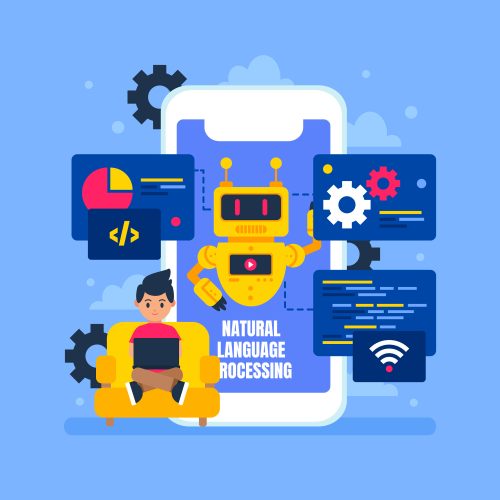
The Natural Language Processing (NLP) course is designed to give you a comprehensive understanding of how machines interpret, analyze, and generate human language. In today’s AI-driven world, NLP powers everything from chatbots and virtual assistants to sentiment analysis systems and recommendation engines. This program takes you from foundational concepts to advanced NLP models used in real-world applications.
By the end of the course, you will be equipped to build intelligent text-processing systems, perform sentiment analysis, develop chatbots, and deploy NLP solutions in production environments. Whether you’re a data scientist, developer, researcher, or AI enthusiast, this course provides both the theoretical depth and practical exposure needed to master NLP confidently.
Course Objectives
- Master the core concepts and techniques of Natural Language Processing.
- Learn how to preprocess and clean text data for machine learning tasks.
- Explore advanced NLP applications such as sentiment analysis, named entity recognition, and language generation.
- Gain hands-on experience with popular NLP libraries including NLTK, SpaCy, and Hugging Face.
- Build practical NLP solutions across industries such as healthcare, finance, and customer service.
What Will You Learn (Modules)
Module 1: Introduction to NLP and Text Preprocessing
- Overview of NLP concepts, applications, and real-world challenges.
- Text preprocessing techniques: tokenization, stopword removal, stemming, and lemmatization.
- Building your first NLP pipeline for text cleaning and preparation.
Module 2: Exploring NLP with Python
- Working with Python NLP libraries such as NLTK, SpaCy, and Gensim.
- Text analysis techniques including frequency distribution and tokenization.
- Understanding and implementing word embeddings like Word2Vec, GloVe, and FastText.
Module 3: Text Classification and Sentiment Analysis
- Building text classification models for spam detection and sentiment analysis.
- Feature extraction techniques: Bag-of-Words, TF-IDF, and word embeddings.
- Hands-on project using real-world datasets such as movie reviews and social media data.
Module 4: Named Entity Recognition (NER) and POS Tagging
- Understanding Named Entity Recognition and its business applications.
- Extracting entities such as dates, locations, organizations, and more.
- Using Part-of-Speech tagging and syntactic parsing to analyze sentence structure.
Module 5: Advanced NLP Models – Transformers and BERT
- Introduction to Transformer architecture and its impact on NLP.
- Understanding BERT and pre-trained language models.
- Implementing transformer models for classification and question answering.
Module 6: Text Generation and Chatbot Development
- Designing and building NLP-powered chatbots.
- Text generation using RNNs and Transformers.
- Exploring GPT-based models for language generation, summarization, and translation.
Module 7: NLP in Real-World Applications
- Industry use cases in healthcare, finance, marketing, and customer service.
- Information retrieval systems and recommendation engines.
- Hands-on project applying NLP to customer reviews or domain-specific datasets.
Module 8: Model Evaluation and Deployment
- Evaluating NLP models using precision, recall, F1-score, and confusion matrices.
- Fine-tuning and optimizing models for improved performance.
- Deploying NLP solutions via APIs and cloud platforms.
Module 9: Ethics and Bias in NLP
- Understanding bias, fairness, and inclusivity in language models.
- Identifying and mitigating bias in datasets and algorithms.
- Building responsible and ethical NLP systems aligned with AI best practices.
Final Project
In the final project, you will develop a complete NLP solution tailored to a real-world challenge.
- Design and implement a text classification, sentiment analysis, or chatbot system.
- Work with real-world datasets in domains such as healthcare, finance, or social media.
- Build, evaluate, and deploy your NLP model as a functional solution.
Who Should Take This Course?
This course is ideal for:
- Data Scientists & ML Engineers: Looking to specialize in NLP applications.
- Developers: Interested in building intelligent text-based systems.
- Students & Researchers: From computer science, AI, and linguistics fields.
- Business & Analytics Professionals: Working with large volumes of text data.
Job Opportunities
Upon successful completion, you can explore roles such as:
- Natural Language Processing Engineer
- AI Researcher (NLP)
- Data Scientist – NLP Specialist
- Machine Learning Engineer (NLP Focus)
- AI Chatbot Developer
Industries hiring NLP professionals include AI product companies, tech startups, healthcare organizations, financial institutions, research labs, and customer service automation firms.
Why Learn With Nanoschool?
At Nanoschool, we focus on blending deep technical expertise with practical implementation.
- Hands-On Learning: Work on real datasets and deploy real NLP solutions.
- Industry-Relevant Curriculum: Covering modern transformer models and deployment practices.
- Expert Guidance: Learn from professionals experienced in AI and NLP applications.
- Certification & Assessment: Earn digital certification upon successful completion.
- Career-Focused Training: Build a portfolio-ready final project to showcase your skills.
Key Outcomes of the Course
- Strong foundation in NLP concepts and practical implementation.
- Ability to build and deploy NLP models for classification, sentiment analysis, and entity recognition.
- Hands-on experience with Python-based NLP frameworks.
- Understanding of ethical challenges and bias mitigation in NLP systems.
- Confidence to apply NLP techniques to real-world business and research problems.